Origin and Intent
Before the archive
I had been working on this material for several weeks before the archive visit gave the project its angle. The subject was already the Executed Renaissance: the generation of Ukrainian writers, theatre-makers, artists and intellectuals who flourished during the 1920s under korenizatsiya, and were then executed, imprisoned or driven to suicide under Stalin in the 1930s (Tokarsky, 2021). What I did not yet have was the lens through which to read it as a design problem.
What the map made visible
That lens arrived in an archive. I was looking at a 1975 Soviet military survey of Manchester and Salford. What disturbed me was not that the map was aggressive or openly propagandistic. The opposite was true: precise, quiet, technically impressive. Industrial and military sites were calmly classified. Cyrillic annotations sat neatly over British urban space. The main roads into Manchester were drawn thick and bright. It was something more disciplined than propaganda.
I write this as a Ukrainian. The map mattered to me before I could explain why. It was the same calm, technical confidence with which my own country had been described, classified and filed for most of its modern history. The map gave me a way to name what the project had been circling: not the executions themselves, but the system of representation that made the executions possible — and the system that has continued to misplace their work ever since.
What the prototype argues
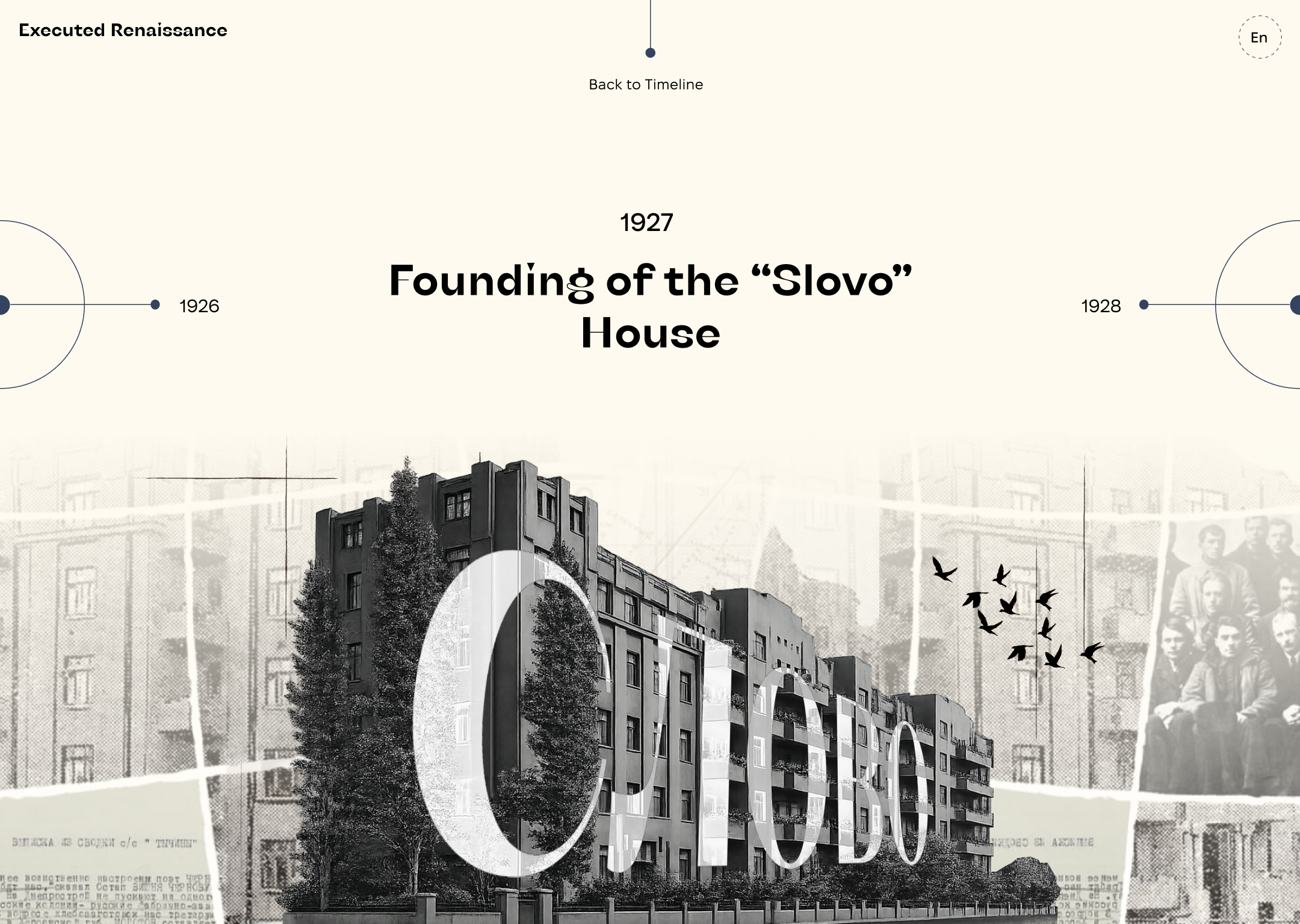
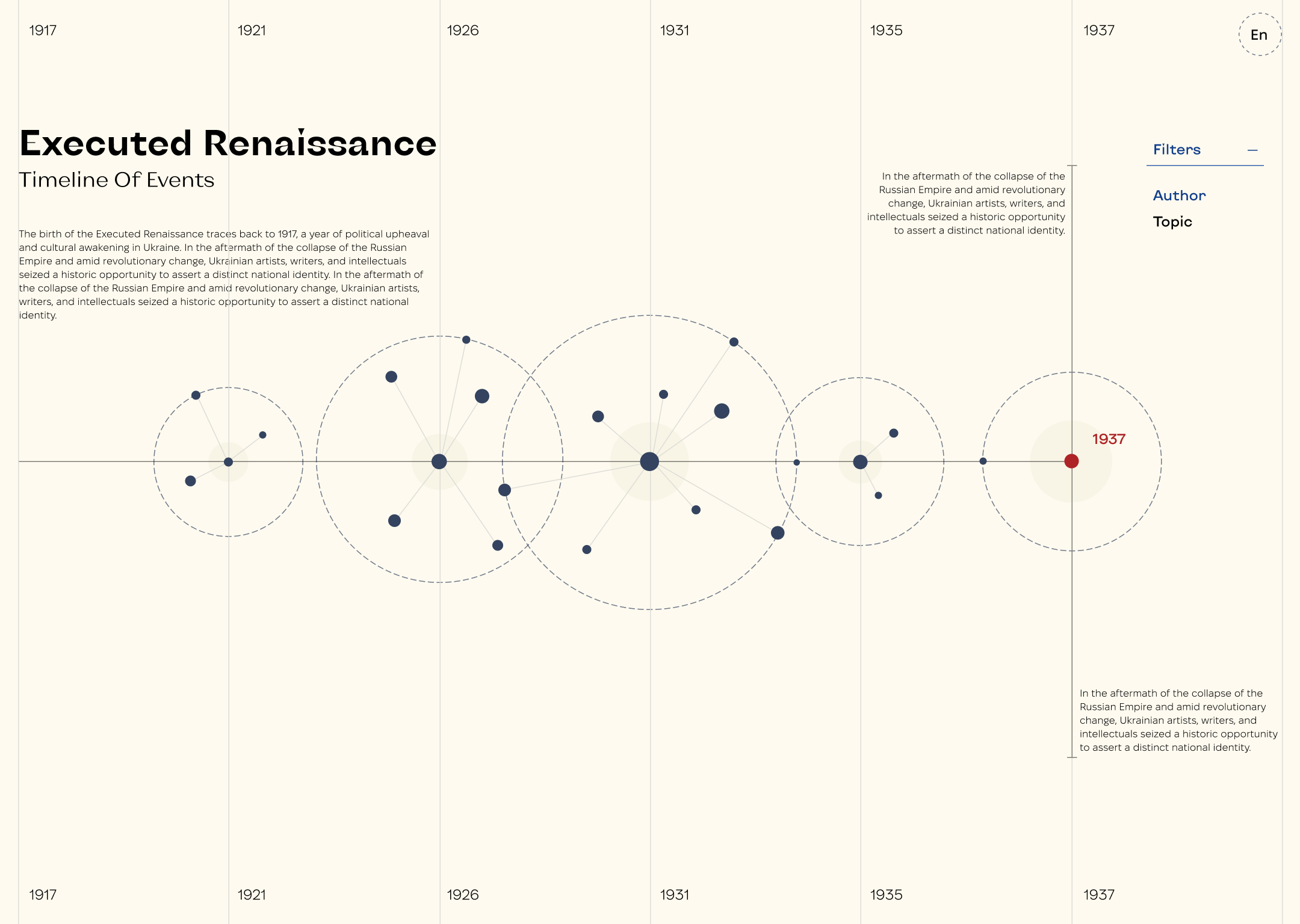
The project is an interactive web timeline on the Executed Renaissance. The prototype argues one specific claim. Ukrainian culture belongs to independent European tradition, not to the Russian-imperial frame that has often classified it as rural, secondary or "Russian-adjacent". This is not an encyclopaedia. It is a designed argument about placement, omission and recovery (Figure 1).
Brief, audience and structure
The project responds directly to the module brief, which asks for a visual essay or prototyped interaction exploring technology and its entanglement with colonialism (Manchester Metropolitan University, 2026). Colonialism in this project is not only physical control of territory. It is also control of representation: who is named, where they are placed, which histories become visible, and which are made to look like footnotes to a larger culture.
The intended user is specific: international humanities students who may know Ukraine as politically distinct from Russia but do not know its modernist history. This is the audience for whom the older stereotype of Ukrainian culture as a countryside satellite of Russian culture still works. Ukrainian people mostly know this history already. The prototype is not optimised for them.
The following essays explain the project in order. Essay 2 defines the historical and theoretical problem the map opened. Essay 3 explains how the research shaped visual and interaction decisions for that user. Essay 4 documents the build, the production choices, and the current limitations of the prototype.
References
Manchester Metropolitan University (2026) Assessment Brief 1J6Z1025: What is Work in a Digital World. Unpublished module handout. Manchester: Manchester Metropolitan University.
Tokarsky, B. (2021) The Un/Executed Renaissance: Ukrainian Soviet Modernism and Its Legacies. Essays of the Forum Transregionale Studien, 8/2021. Berlin: Forum Transregionale Studien. Available at: **https://doi.org/10.25360/01-2021-00016** (Accessed: 14 March 2026).