From Theory to Interface
Choosing the form
Essay 3 set out the design stance. Essay 4 is the build itself: the form choice, the production work, the deployment, and what the prototype still cannot do. It also connects most directly to the module's learning outcomes, because I was working not only as designer, but also as curator, art director and developer.
The first decision was form. Three options were on the table. A static editorial site would be readable, but too fixed; it could not let the reader experience historical density. A video essay could control emotion, but it removed user agency, and the user — the non-specialist humanities student — needs agency more than they need atmosphere. A map-based piece was conceptually strong because the project had started from cartography, but it made geography too dominant and could not communicate the acceleration from the 1920s to the violence of the 1930s. The interactive timeline was chosen because it could hold continuity and rupture in one structure. It also supports progressive disclosure: the user first sees the whole period, then opens years, figures and artefacts at their own pace.
Production and time
Production planning then moved through four stages: visual research, wireframes, style tests and implementation. The visual research looked at Soviet military maps, Ukrainian avant-garde typography, Constructivist theatre posters, book covers and archive interfaces. I used this research to test what the project should not become as much as what it should become. A museum-like layout felt too neutral. A folkloric direction would repeat the stereotype the project criticises. A propaganda-like direction became too celebratory and too close to Soviet authority. The final direction came from removing those options and keeping a stricter system of type, red, black, paper texture, grid and montage.
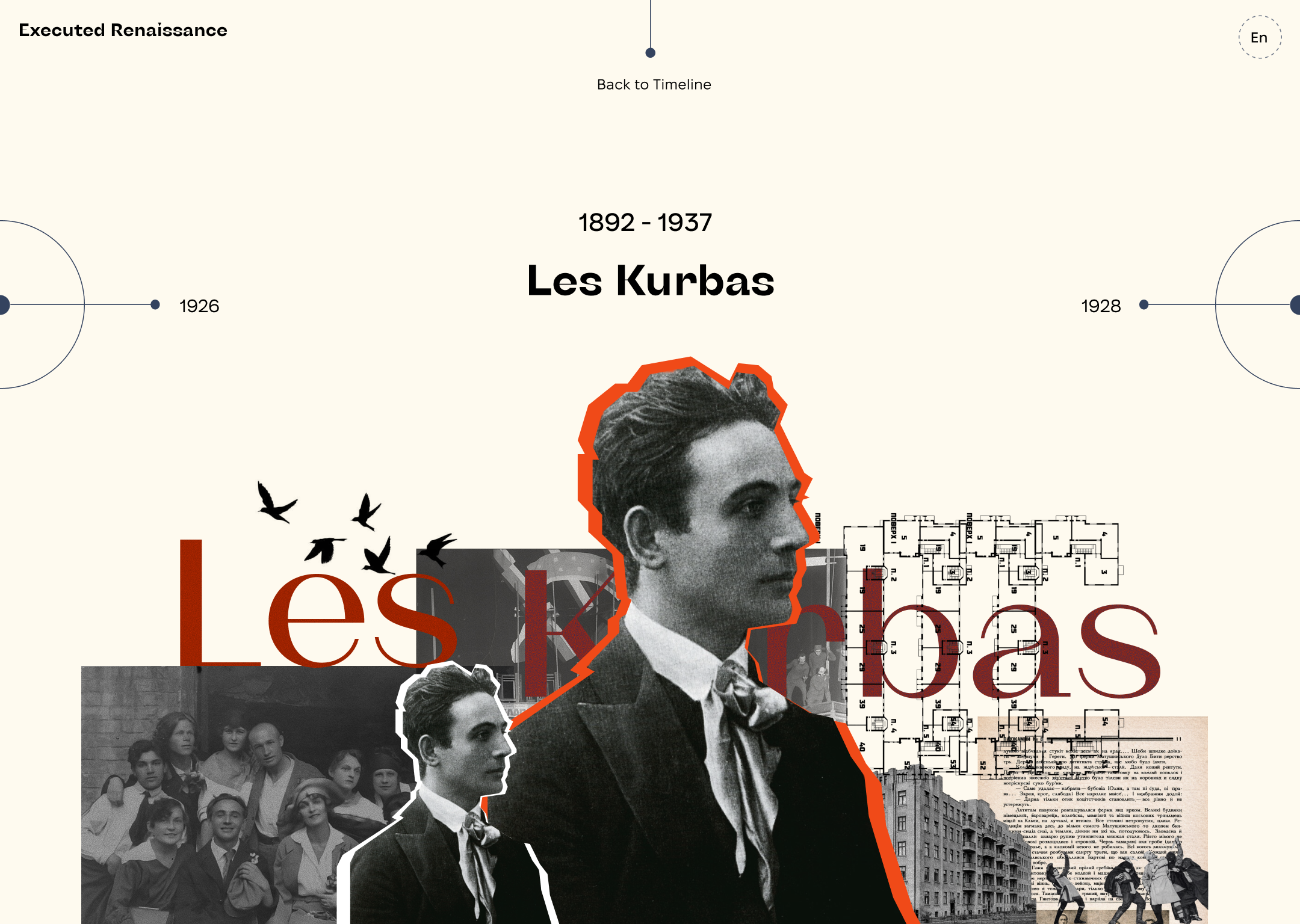
The hardest design problem was representing uneven historical time. Events are not distributed neatly. Some years are dense, some are nearly empty, and 1937 becomes catastrophic. A strictly proportional timeline created clustering and dead space. The solution was an expandable structure: entries can cluster into broader year groups at overview scale, then open into more specific years and events. This makes density visible without pretending that history is tidy. For the non-specialist reader, it also means they can find the catastrophe in the rhythm of the timeline itself, before reading any caption (Figure 5).

Because I chose a prototyped interaction rather than film, production values shifted away from audio and colour grading towards motion, hierarchy, image design and interaction feedback. Sound design was not primary in this outcome. The equivalent production concern was the rhythm of movement: idle breathing, zoom behaviour, overlay transitions and the moment when individual events open from the wider archive field (Figure 6). These became the cinematic layer of the piece.

Stack and deployment
The prototype was built in React, styled with Tailwind CSS and animated with Framer Motion, then deployed through Vercel. This is not just technical detail. It changes what the work is. A deployed prototype can be linked, tested and encountered without a gallery or institution. This speaks to the future of digital design work: designers increasingly operate between interface design, cultural research, curation, publishing and platform infrastructure. The work is not only making screens. It is deciding what becomes visible, under which structure, and for whom.
Limitations
The prototype also shows limitations. The core concept, visual direction and interaction logic are implemented, but the work is not complete. Content depth is partial. Onboarding still needs to be clearer for a reader who arrives without context. The target audience has not been properly tested. Some interactions may be cognitively demanding at first encounter. I see this as a serious prototype, not a finished product.
Position and closing
The choice I remain most confident in is the non-neutral position. Pretending objectivity would contradict the project. The history is already political because the archive itself was part of the problem. The position was named in Essay 1; my responsibility now is to hold it to evidence. The timeline ends visually and conceptually at Sandarmokh, the 1937 execution site where Kurbas, Kulish and many others were shot. It does not offer easy resolution.
This project does not solve erasure. It is selective, interpretive and unfinished. But it demonstrates how a digital product can respond to an ethical issue by making suppressed material visible in a specific form. It places the Executed Renaissance as a historical formation in its own right, not as a footnote to another culture.
References
Manchester Metropolitan University (2026) Assessment Brief 1J6Z1025: What is Work in a Digital World. Unpublished module handout. Manchester: Manchester Metropolitan University.
Tokarsky, B. (2021) The Un/Executed Renaissance: Ukrainian Soviet Modernism and Its Legacies. Essays of the Forum Transregionale Studien, 8/2021. Berlin: Forum Transregionale Studien. Available at: **https://doi.org/10.25360/01-2021-00016** (Accessed: 14 March 2026).
Final References
Battle-Baptiste, W. and Rusert, B. (eds) (2018) W. E. B. Du Bois's Data Portraits: Visualizing Black America. New York: Princeton Architectural Press.
Benjamin, R. (2019) Race After Technology: Abolitionist Tools for the New Jim Code. Cambridge: Polity.
Bruguera, T. (2012) 'Reflections on Arte Útil', in Arte Actual: Lecturas para un espectador inquieto. Madrid: CA2M Centro de Arte Dos de Mayo, pp. 194–197.
Rankin, W. (2016) After the Map: Cartography, Navigation, and the Transformation of Territory in the Twentieth Century. Chicago: University of Chicago Press.
Tokarsky, B. (2021) The Un/Executed Renaissance: Ukrainian Soviet Modernism and Its Legacies. Essays of the Forum Transregionale Studien, 8/2021. Berlin: Forum Transregionale Studien.