Archive as Argument
A non-neutral archive
Essay 2 defined the problem: Ukrainian modernism was not only physically suppressed, but repeatedly misclassified. This changed the design task. I could not make the prototype as a neutral container of information. If the archive is part of how cultures are placed, then my archive had to take a position on placement.
The user shapes that position. The international humanities student does not arrive with the historical knowledge a Ukrainian reader has. They have to be moved through the material at a pace that respects them but does not protect the history. The design choices that follow — visual register, ordering, interaction logic — are answers to that specific reader, not to a general public.
Du Bois: discipline against omission
Du Bois gave me the first design strategy. His data portraits for the 1900 Paris Exposition used charts, diagrams and statistical typography to make Black American life visible inside a colonial exhibition context (Battle-Baptiste and Rusert, 2018). He did not reject the visual language of authority. He used it against the omission it usually supported. I take this as a model: visual systems can answer exclusion when they are disciplined enough to be taken seriously.
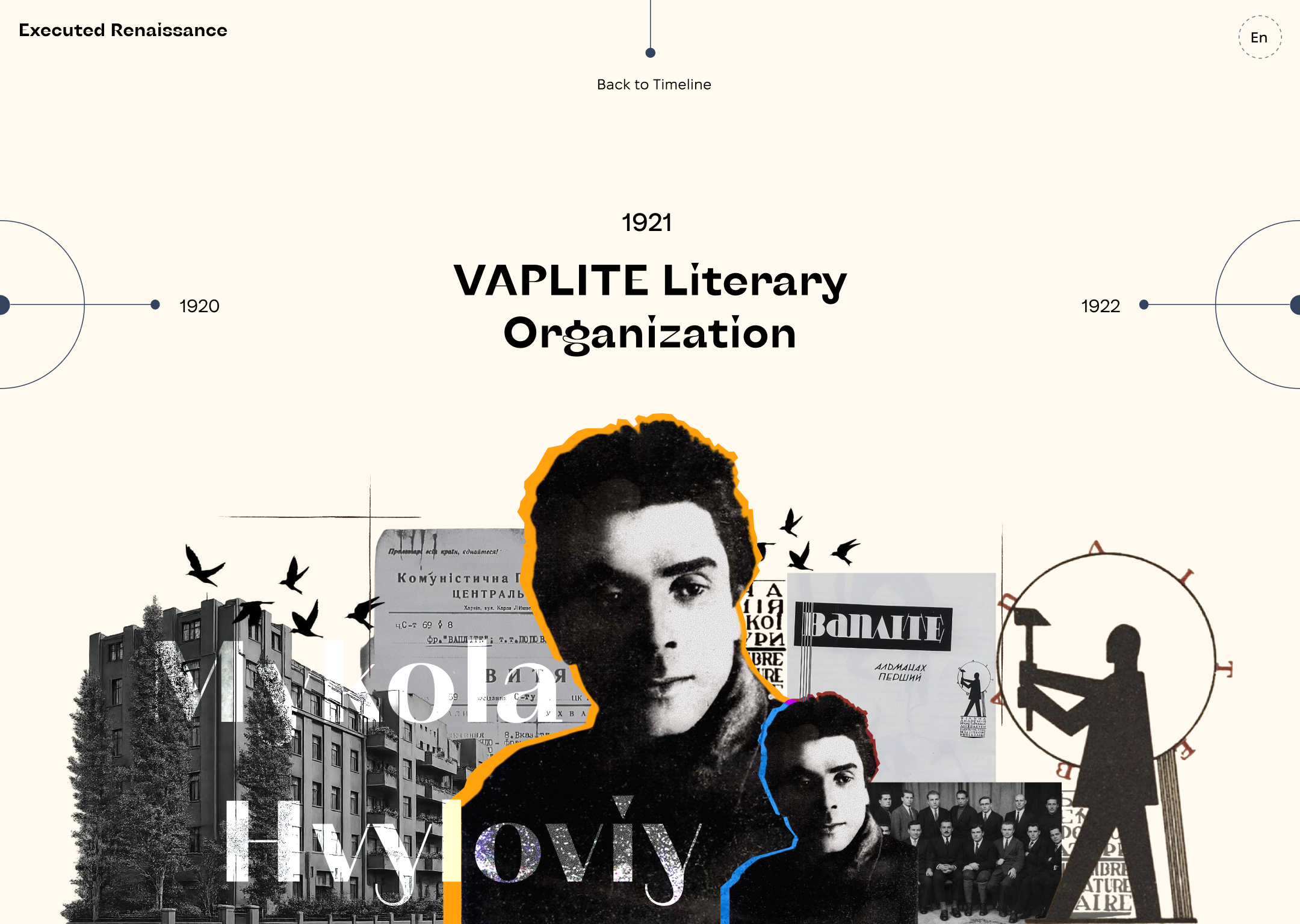
My project borrows that seriousness, but not the same neutral tone. I want the prototype to be archivist, not purely archival. It should have structure, evidence and restraint, but also a visible point of view. The visual thesis is a calm archival machine where geometry, typography and montage carry emotion, and red appears as rupture rather than decoration (Figure 3).
Bruguera: interaction as use
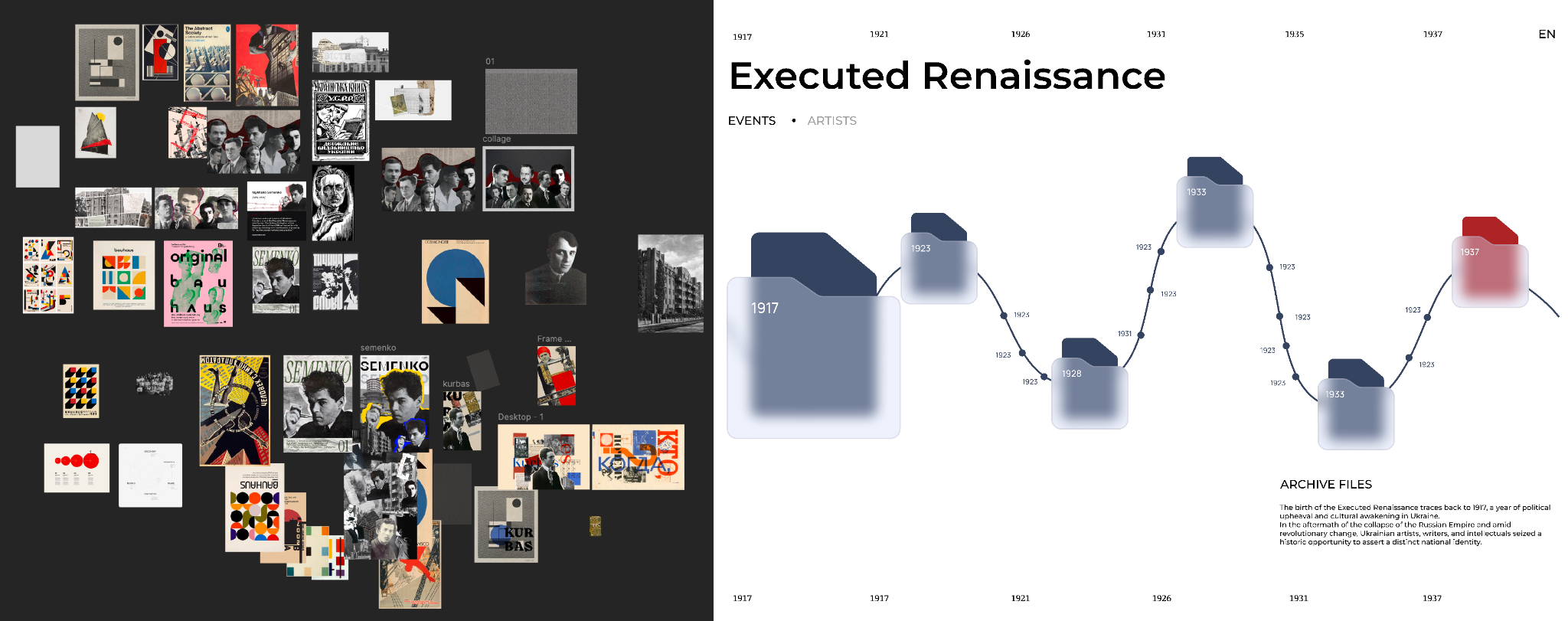
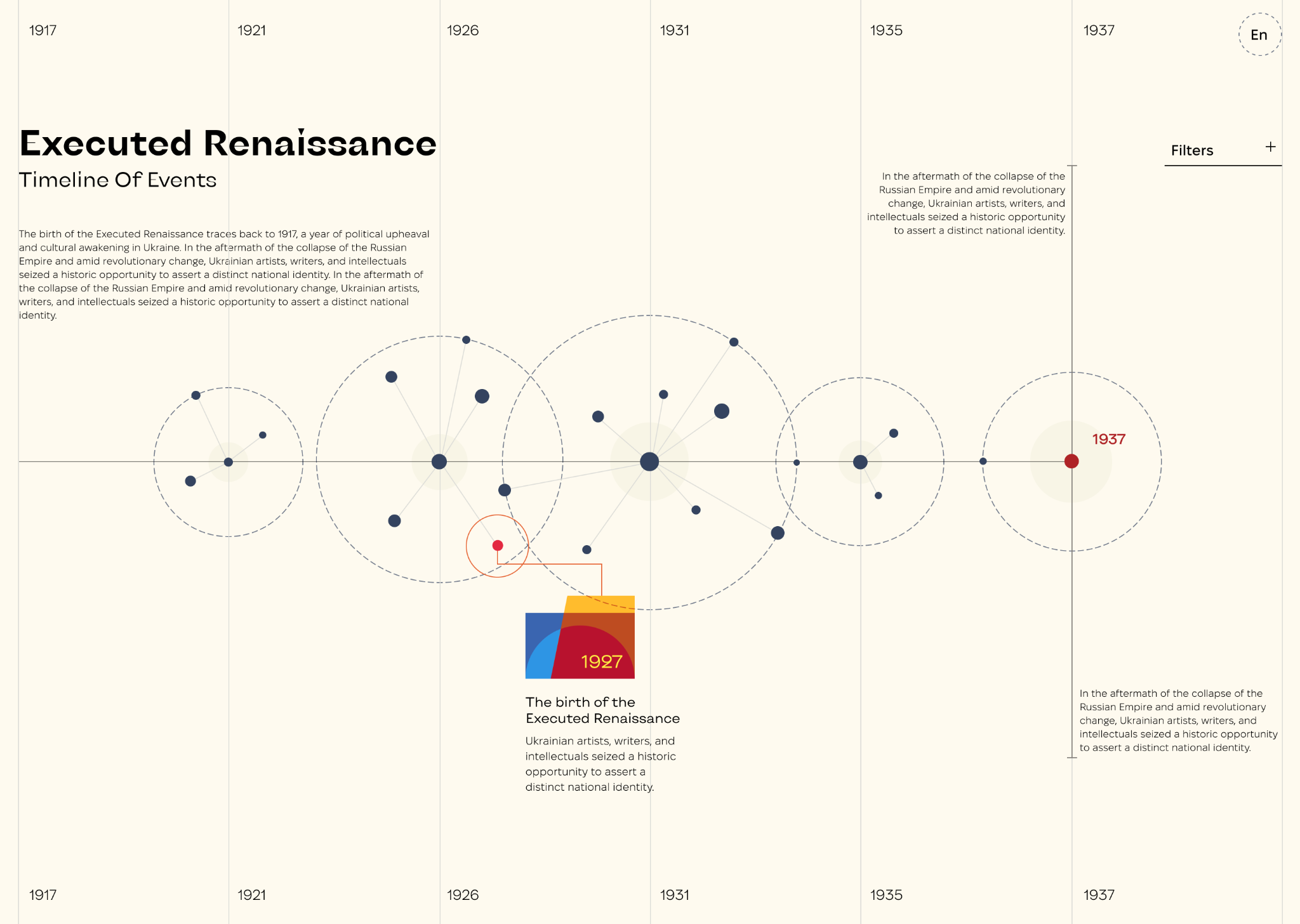
Bruguera gave me the second test. Her idea of Arte Útil asks art to become useful, not only expressive. She writes that art should "start practising the future" and that Arte Útil transforms "affectiveness into effectiveness" (Bruguera, 2012, pp. 194-195). For my prototype, this means interaction cannot be decoration. The reader must be able to do something: move through years, open figures, compare events, return, and build understanding at their own pace (Figure 4). This matters most for the non-specialist user. They need agency, not a guided tour.
Constructivism as Ukrainian avant-garde
The Constructivist aesthetic is the third decision. I did not choose it because it looks Soviet or fashionable. Constructivism was one of the working visual languages of the Ukrainian avant-garde: geometry, photomontage, strong typography, theatre posters, Futurist layouts and experimental book design. Socialist Realism was imposed in 1934 and suppressed this visual language alongside many of the people who used it (Tokarsky, 2021). Using Constructivist language now places Ukrainian modernism inside the European avant-garde, where it belongs, rather than inside a folkloric stereotype.
Naming the risk
The risk in this choice is real, and I want to name it clearly. Constructivism is also entangled with Soviet visual culture. Its forms were used by the same state that later destroyed Kurbas, Kulish and the others. To borrow that language without thinking is to borrow the aesthetic of the executioner to mourn the executed. I tried to manage this by avoiding a triumphal propaganda tone. The interface keeps the order of the avant-garde but refuses its celebration. Red is reserved for rupture and warning, never decoration. I do not believe this fully resolves the contradiction. I believe naming it is part of the work.
References
Battle-Baptiste, W. and Rusert, B. (eds) (2018) W. E. B. Du Bois's Data Portraits: Visualizing Black America. New York: Princeton Architectural Press.
Bruguera, T. (2012) 'Reflections on Arte Útil', in Arte Actual: Lecturas para un espectador inquieto. Madrid: CA2M Centro de Arte Dos de Mayo, pp. 194-197.
Tokarsky, B. (2021) The Un/Executed Renaissance: Ukrainian Soviet Modernism and Its Legacies. Essays of the Forum Transregionale Studien, 8/2021. Berlin: Forum Transregionale Studien. Available at: **https://doi.org/10.25360/01-2021-00016** (Accessed: 14 March 2026).